

The Legend That Refuses to Sink
Few stories in history have captured the human imagination quite like the lost city of Atlantis. It’s a tale that’s lasted for over 2,000 years — a city said to be swallowed by the sea “in a single day and night of misfortune.”
Whether you picture marble palaces glowing beneath crystal-blue waters or a once-mighty empire doomed by its own arrogance, Atlantis has become the ultimate symbol of lost civilizations.
And while stories of vanished worlds aren’t rare — from Pompeii’s tragic eruption to Thera’s volcanic destruction — Atlantis feels different. It isn’t just about ruins. It’s about possibility.
The question that keeps us searching is simple:
Was Atlantis ever real?
Before we go diving for answers, let’s travel back to where the legend began — with one of history’s greatest philosophers.
Plato’s Story: Where the Legend Began
Atlantis didn’t come from a modern myth or sailor’s tale. It came straight from Plato, the Greek philosopher who also gave us lessons on justice, politics, and the ideal society.
Around 360 BCE, in his dialogues Timaeus and Critias, Plato described a powerful island nation located “beyond the Pillars of Hercules” — what we now call the Strait of Gibraltar.
According to him, Atlantis was a technologically advanced empire with grand temples, fertile farmland, and an organized government that rivaled anything in ancient Greece. The people were intelligent, creative, and prosperous.
But success led to arrogance. The Atlanteans, Plato said, became greedy and corrupt, defying the gods who had once blessed them. Their punishment came swiftly — earthquakes, floods, and a single, catastrophic night that sent the island beneath the waves forever.
Plato’s account was meant to be a warning against pride and moral decay, not a history lesson. Still, people throughout time couldn’t resist wondering if the story might have roots in truth.
It’s not the first time a philosopher’s tale took on a life of its own. We’ve seen similar echoes in history — like how ancient Egyptians documented lost lands and strange visitors, as explored in The First Cities Emerge in Mesopotamia — blending myth with memory.
And just like those early civilizations, Plato’s Atlantis would continue to inspire dreamers for centuries.
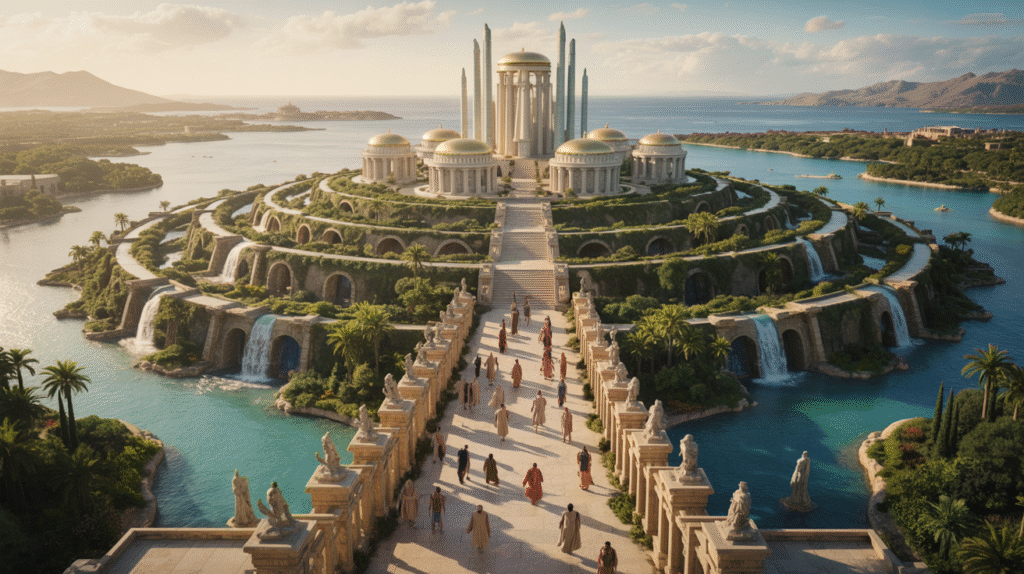
What Atlantis Might Have Looked Like
Plato painted Atlantis as a stunning paradise built in concentric circles of land and water — a design that has fascinated historians and artists alike.
Its central temple, dedicated to Poseidon, supposedly shimmered with orichalcum, a mythical metal said to glow like fire. Around it stretched gardens, canals, and bridges connecting the inner city to outer rings of farmland and docks.
Everything about Atlantis suggested balance — harmony between humans, nature, and the gods. But as greed replaced virtue, that balance collapsed.
If you’ve ever marveled at ancient achievements like the Great Pyramid of Giza, or how early engineers created massive temples like those in Mesopotamia, it’s easy to understand why people believe Atlantis could have existed. These were societies that defied the odds — much like the builders behind The Making of the Statue of Liberty’s Head.
The difference?
Atlantis vanished without a trace.
That mystery — an advanced world lost overnight — became the fuel for centuries of obsession.
The Hunt for Atlantis: Chasing Shadows Beneath the Sea
For over two millennia, explorers, scientists, and even treasure hunters have searched for Atlantis, convinced there must be something left behind.
The Age of Exploration sparked new theories. Some believed Atlantis lay in the Atlantic Ocean, others in the Caribbean, and some even suggested it was buried beneath Antarctica’s ice. Each theory found its believers, fueled by ambition and imagination.
- The Mediterranean Theory links Atlantis to the Minoan eruption on Thera (Santorini) — a real event that wiped out a thriving civilization. You can see parallels to that story in how nature reshaped nations, much like in How Gas Rationing Worked in World War II — sudden, devastating shifts in everyday life.
- The Spain Hypothesis points to ancient ruins near Cádiz that match Plato’s circular layout.
- The Caribbean Theory draws comparisons between Atlantis and Mayan or Aztec ruins.
- The Antarctic Theory, though wildly popular online, remains unsupported by science.
Even with sonar mapping and satellite imagery, no definitive proof of Atlantis has ever surfaced. Still, the search continues — not because of logic, but because of hope.
It’s the same type of curiosity that makes people wonder about unsolved moments in history, from The Mystery of the Missing Scooby-Doo Gummies to The Untold Story of Nancy Green — The Real Aunt Jemima.
When something disappears without explanation — whether it’s candy, culture, or a civilization — we can’t help but want answers.
That’s what keeps Atlantis alive.
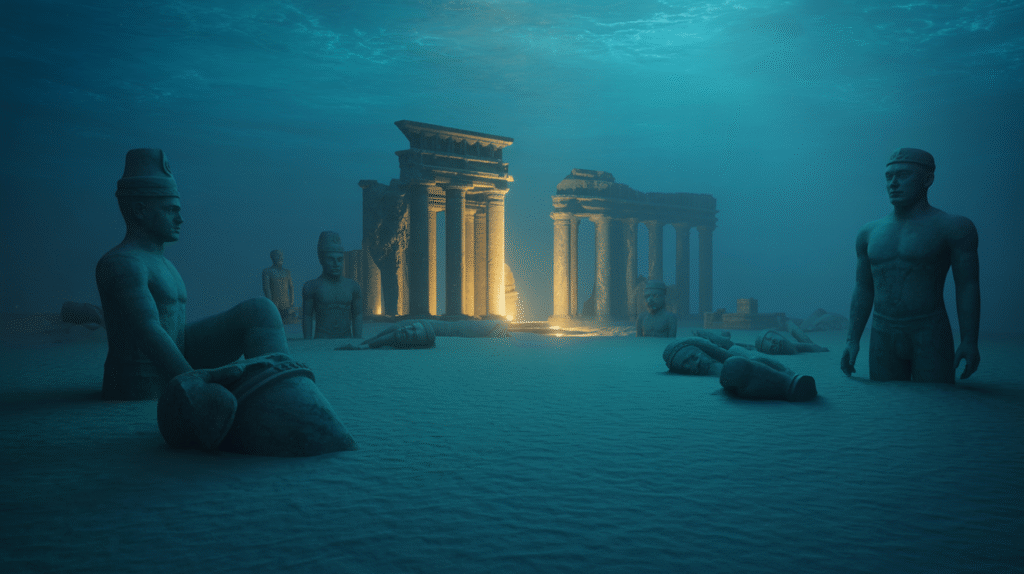
Why We Can’t Stop Believing
Every few years, a headline surfaces claiming “Atlantis Found!” — often with grainy sonar images or underwater shapes that almost look like walls or streets. But each claim eventually fades away.
Yet, no myth ever stays buried for long.
Why does this one keep coming back?
Atlantis speaks to something deeper — the human desire to believe we’ve lost something extraordinary. It’s the same feeling we get when we look back at Life in 1950s Small-Town America or The Dawn of a New Century: A Glimpse Into the Year 1900.
We crave connection to what’s gone — proof that the golden ages we dream about might have really existed.
Atlantis also represents perfection undone. A powerful empire that fell because of pride and greed feels hauntingly familiar, doesn’t it? From ancient Rome to modern societies, the message repeats: when arrogance outweighs humility, collapse follows.
That warning makes Atlantis more than a legend — it’s a reflection of us.
Modern Theories: Science Meets the Sea
In the 21st century, the hunt for Atlantis has shifted from dusty legends to deep-sea data. Researchers use satellite imaging, sonar mapping, and ocean floor analysis to search for anything that matches Plato’s description.
In 2009, Google Earth users thought they’d found the lost city off the coast of Africa — a perfect grid pattern deep beneath the ocean’s surface. The news spread fast. But Google quickly confirmed the “ruins” were simply sonar mapping tracks left by survey vessels. Atlantis had fooled us again.
Still, scientists haven’t stopped looking. Studies of ancient flood patterns, shifting tectonic plates, and massive underwater landslides suggest parts of the Mediterranean and Atlantic may have once held advanced settlements now buried by time.
The reality is, Earth has a way of hiding its history. Just ask anyone who’s studied When Missouri Streets Were Laid by Hand in 1906 — humans leave their mark, but nature eventually takes it back.
Even with advanced tools, Atlantis remains elusive. Maybe that’s the point. The story keeps us curious, forcing us to look deeper — both into the ocean and into ourselves.
Real-World Inspirations: Lost Civilizations That Actually Existed
While the exact location of Atlantis may forever remain a mystery, history offers real civilizations that mirror its story— advanced, powerful, and tragically destroyed.
One of the strongest candidates is the Minoan civilization on the island of Santorini (Thera). Around 1600 BCE, a volcanic eruption so massive it reshaped the island wiped out entire communities overnight. Some historians believe Plato may have based Atlantis on the memory of this disaster.
Another possibility is Helike, an ancient Greek city that literally sank into the sea during an earthquake in 373 BCE. The story was well-known in Plato’s time, and the parallels are hard to ignore.
And beyond Greece, there are echoes everywhere — from the Maya cities overtaken by jungle to Pompeii’s ash-covered ruins. Humanity has lost great civilizations before, just as we chronicled in The Rise and Fall of the Aztec Empire and Pompeii: The Day the Sky Fell.
Each one reminds us that no matter how advanced we think we are, nature always has the final word.
So maybe Plato didn’t make Atlantis up entirely. Maybe it’s not about one lost city at all — but every great civilization that fell and was forgotten.
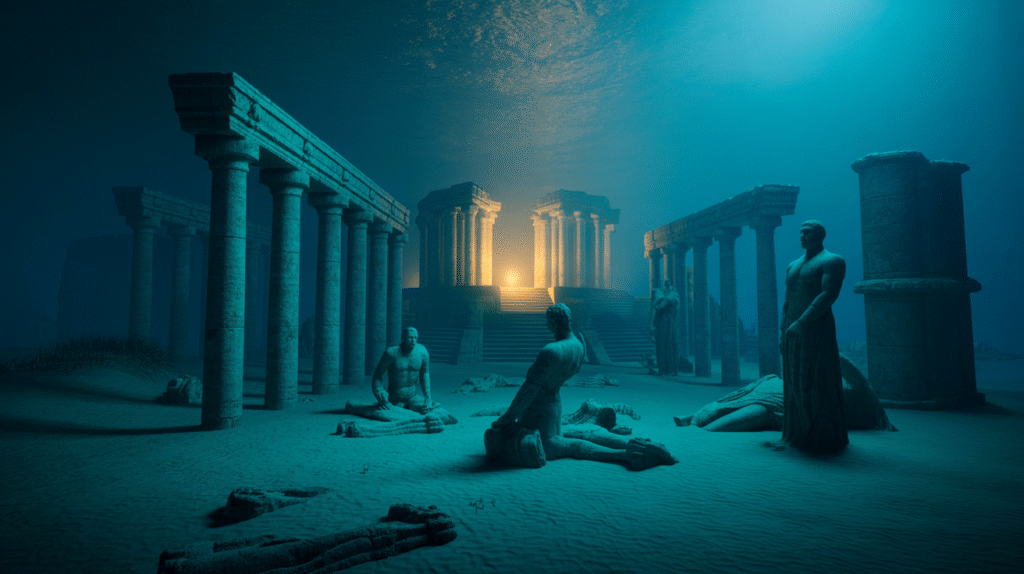
Atlantis in Pop Culture and Conspiracy
If Plato gave birth to Atlantis, pop culture raised it. Over the past century, the story has evolved from an ancient warning to a billion-dollar fascination.
Movies like Aquaman, Atlantis: The Lost Empire, and Journey to the Center of the Earth have turned the myth into pure spectacle — glowing cities, ancient technology, and mysterious sea gods. Meanwhile, conspiracy theorists spin wilder tales, claiming survivors of Atlantis went on to build the Egyptian pyramids or even guide early Native American civilizations.
These ideas may sound far-fetched, but they highlight how deeply the legend resonates. Every culture wants to believe they’re connected to something ancient, powerful, and mysterious.
That fascination fuels everything from YouTube documentaries to late-night Reddit debates. And it’s part of the same energy that drives people to read stories like When the First Gas Station Changed America in 1907 or B-17 Bombers: Flying Straight Through the Flak-Filled Skies Over Germany.
It’s not just curiosity — it’s the thrill of rediscovering what history tried to hide.
In an age of endless information, Atlantis remains the one story we still can’t fact-check. That’s why it endures.
Myth, Memory, or Warning?
Maybe Atlantis never existed as a physical place. Maybe it’s something much bigger.
Plato could have crafted it as a philosophical mirror — a story about human arrogance and the consequences of ignoring moral limits. Yet, every time we see another coastal city flooded, or headlines about ancient ruins uncovered beneath sand or sea, it’s hard not to wonder if history keeps repeating itself.
Atlantis may not be real, but the lesson behind it definitely is. Civilizations rise, thrive, and crumble — often because of the same human flaws Plato warned about 2,000 years ago.
And that’s why the story still matters.
It’s the same spirit that drives the fascination behind When Missouri’s Brick Roads Were Laid by Hand, or Fairfield Inn and Suites Liberty, MO: Our Unfiltered Experience: uncovering what’s been forgotten, understanding what we’ve learned, and keeping history alive through storytelling.
Atlantis might be buried deep under the ocean, or maybe it never existed at all. Either way, its message still floats — a warning against pride, and a reminder that what’s lost can still teach us.
As an Amazon Associate we earn from qualifying purchases through some links in our articles.